The Field of the Cloth of Gold, near Calais, 1520
When Kings Tried to Out-Host Each Other
In June 1520 Henry VIII and Francis I met to make peace, and spent eighteen days trying to out-host each other in glass, canvas, gold and wine.
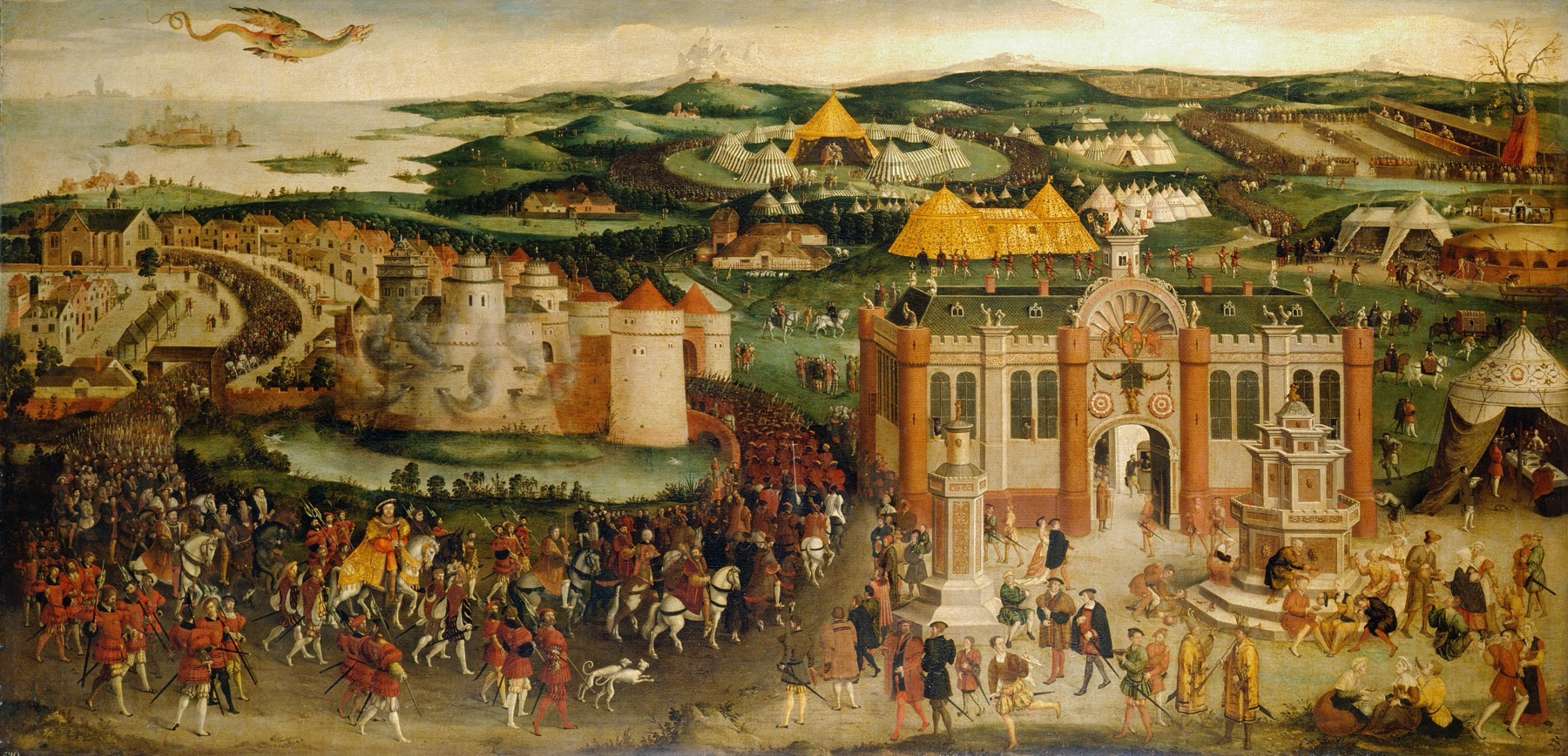
On Sunday 10 June 1520, two kings set out for dinner at exactly the same moment, in opposite directions. Francis I of France rode to the English camp at Guînes to dine with Henry VIII's queen, Catherine. Henry VIII rode to the French camp at Ardres to dine with Francis's queen, Claude, and his mother, Louise of Savoy. Neither king hosted the other. Each was the guest of the other's wife.
The timing was not good manners. It was security. As the French courtier Fleuranges, who was there, put it, "each of them was a hostage for the other." For as long as dinner lasted, each court held the other's king.
That is the Field of the Cloth of Gold in one evening: a peace summit staged as a hosting contest, so carefully balanced that the two hosts could never quite sit at the same table.
A summit by appointment
The meeting was Cardinal Thomas Wolsey's project. It grew out of his 1518 Treaty of London, the "universal peace" that called for the two kings to meet. They did so from 7 to 24 June 1520 in the Val Doré, a valley between English Guînes and French Ardres, in the English territory around Calais. A French pamphlet printed that summer records the detail that mattered to the English: the kings met "in English ground".
Both sides came in strength. The counts disagree, but there were some five thousand people or more on the English side alone, with thousands of horses. One French newsletter reports that proclamations had to send home "more than 10,000 persons who had no business at the camp".
Henry builds a house
England's answer to the occasion was a palace built in a field in under three months. The commissioners arrived on 17 March and work began two days later; the Chronicle of Calais lists "iii c. masons and v c. carpentars, one c. joynars ... to the nombar in all ij m. and more" (other sources put the workforce higher). The timber came from Holland in rafts, because the beams were too long for any ship.
The result, according to the chronicler Edward Hall, was a square around a courtyard, each side 328 feet long. It stood on a base of stone and brick, with a timber frame and walls of canvas painted to look like brick. Much of it was glass: half the house, Fleuranges wrote, so that it was very bright inside. Within, the walls were hung with cloth of gold and silver and with tapestries, the chapel was done in blue and gold, and the cellar, a contemporary account noted, was "most excellently stored". Henry slept in the old castle at Guînes and spent his days in the new house.
It was built to compete. A Mantuan envoy who was there wrote that the English devised the house because of the fame of Francis's tent, "from rivalry, and with a view to being equally well lodged in a different fashion". Fleuranges, a Frenchman with no reason to flatter the English, admitted it was "much finer than the French ones, and cheap".
At the gate stood the hospitality everyone remembered. Hall describes a gilded fountain of Bacchus running with "red, white, and claret wyne" under the motto Faicte bonne chere quy vouldra: make good cheer, whoever will. Other witnesses describe different fountains (Cupid and Bacchus pouring malmsey and claret into silver cups, or spouts of spiced hippocras, wine and water), but they agree that the wine flowed for anyone who came. Hall also records the result: "vacaboundes, plowmen, laborers" who "for drunkennes lay in routes and heapes". Around the palace, he says, stood "twentie and eight hundred sundery lodgynges".
Francis pitches a tent
The French went the other way: fabric instead of glass. At Ardres they raised some three hundred to four hundred tents of cloth of gold, cloth of silver and velvet. The king's great pavilion was crowned with a gilded statue of St Michael (hollow, Fleuranges notes). Francis also had a three-storey round house built outside Ardres, in the style of a Roman theatre, on stone foundations. It "ne servit de riens," Fleuranges wrote: it was never used.
The clothes matched the camps. Henry rode to Ardres in "a double mantle of cloth of gold ... embroidered with jewels". A Milanese report says the French wore "gold and silver brocade, for velvets, satins, and other silks were held in no account", and that each English gentleman wore "a massive gold chain". Cloth of gold was silk woven with thread wrapped in beaten gold or silver, the most expensive textile in Renaissance Europe, and English law reserved some kinds of it to the royal family. The French contemporary Martin du Bellay said the courtiers' finery was so lavish "that the gathering was named the Camp of the Cloth of Gold".
The menu
On the English side, at least, the catering was planned like a campaign. An estimate for a month at Calais and Guînes, preserved among the Rutland papers, calls for 340 beeves, 2,200 sheep, 800 calves, 560 tuns of beer and 150 tuns of French and Gascon wine, plus sweet wine and hippocras, poultry worth £1,200 and fish worth £300. It is a plan, not a record of what was eaten, but it gives the scale.
A surviving menu for the king's principal table runs to three courses, each opening with soup, through capon, cygnets, a "carpett of venyson", pike, heron, peacock, storks, egrets, sturgeon and quails, ending in fritters and fruit. Wolsey gave his own banquet on 12 June. "The extreme splendour of his dwelling is incredible," a Venetian wrote home.
Two hosts, one valet
The most charming scene of the fortnight is also one of the best attested, because two eyewitnesses describe it independently. Early one morning Francis rode to Guînes unannounced, woke Henry, and played his valet. The two kings exchanged jewelled collars. The next morning Henry returned the visit.
The weather did not cooperate with either host. On 11 June, the first day of the jousts, "the wind was so strong as to prevent the lances being couched"; on 13 June there was no jousting at all "on account of the high wind". The kings rode on the same side, as challengers, never against each other. Francis's great pavilion "was afterwards blown down and the mast broken", the Mantuan envoy reported, and the French tents "remained up four days only, on account of the wind and rain".
The wrestling match
Which brings us to the most famous story of all, and the shakiest. According to Fleuranges, after a day of jousting and archery the two kings were drinking together in a pavilion when Henry took Francis by the collar and said, "My brother, I want to wrestle with you." Francis, "who is strong and a good wrestler", gave him "a Breton trip" and threw him to the ground. Henry wanted a rematch, but they had to go in to supper.
It is a wonderful scene, and it rests on one witness. No English source mentions it. Fleuranges was a French courtier writing his memoirs some years later, and he gives no date. The historian Joycelyne Russell put it plainly: the English records are silent, but the bout is "mentioned by Florange, an eyewitness". Believe it if you like; just know who is telling it.
The dragon and the reckoning
On Saturday 23 June, Wolsey sang Mass in a chapel built overnight on the tiltyard, with the English and French choirs taking turns. During the service, a contemporary French account records, "a great artificial salamander or dragon, four fathoms long, and full of fire" crossed the sky from Ardres towards Guînes. Whether it was a firework or a kite with fireworks attached, nobody can now be sure.
The treaty was sworn: Henry's daughter Mary would marry the French Dauphin, and France would pay England. Fleuranges judged the terms well drawn, "had they been kept". They were not. Within weeks of leaving the field Henry was meeting Francis's rival, the Emperor Charles V, at Gravelines and Calais. In August 1521 England signed a secret treaty against France at Bruges, and on 29 May 1522 an English herald at Lyon declared Henry the French king's "mortal enemy", citing breaches of "the treaty of Ardre".
The palace was temporary, and so was the peace. What lasted was the reputation of the party.
The Record
- Eyewitness and contemporary sources. Robert de La Marck, seigneur de Fleuranges, Mémoires, vol. 1 (ed. 1913), pp. 262–273: the hostage dinners, the glass house, the French tents, the surprise visit and the wrestling match. Letters and Papers, Henry VIII, vol. 3, June 1520 (a French newsletter of 11 June, a French pamphlet printed that summer, Guillaume Budé's letter): the meeting place, the palace's materials, the reciprocal dinners, the jousting weather and the dragon at the Mass. Calendar of State Papers, Venice, vol. 3, June 1520 (1–5, 6–10, 11–20, 21–30 June), including the Mantuan ambassador Soardino's letter of 26 June on the rivalry between house and tent. These calendars give editors' English summaries, so quotations from them are summaries rather than the writers' own words.
- English chronicles and records. Edward Hall, Hall's Chronicle (1548): the palace's dimensions, the fountain and its motto, the 2,800 lodgings, the drunken crowds and the Mass on 23 June. Hall's own presence is not established; his account seems to draw on an eyewitness journal. The Chronicle of Calais (ed. 1846): the building dates, the workforce and the timber rafts. Rutland Papers (ed. 1842): household lists, the food estimate and the menu.
- Institutions. Royal Collection Trust, The Field of the Cloth of Gold, RCIN 405794; Historic Royal Palaces, "The Field of Cloth of Gold"; V&A, cloth-of-gold fragment, on what cloth of gold was.
- Historians. Joycelyne G. Russell, The Field of Cloth of Gold: Men and Manners in 1520 (1969), on the wrestling (pp. 131–2) and the food accounts (p. 153). Glenn Richardson's The Field of Cloth of Gold (Yale, 2013) is the leading modern study; we have not drawn on it directly.
- What is uncertain. Headcounts differ between sources (the Chronicle of Calais gives 4,334 people with the king and queen, not counting several great households; the Rutland Papers tally gives 5,804), so we say "some five thousand or more". Estimates of the workforce run from 2,000 to 6,000. There is no reliable grand total for what the meeting cost. Accounts of the wine fountains differ in detail. Some modern summaries say the fountains also ran with beer; no contemporary account we have seen says so. Some summaries also place the Mass on 24 June, but Hall and the French accounts give Saturday 23 June.
- Disputed anecdotes. The wrestling match rests on Fleuranges alone and is undated; English sources are silent. Popular retellings add that Henry had been drinking heavily, that Francis could not draw Henry's bow, that the French called the palace a "Crystal Palace", and that the two kings made a pact about their beards. We have not found a contemporary source for any of these, and have left them out.
- The painting. Painted about 1545, a quarter-century after the event, probably for Henry VIII. It combines several days into one scene and shows a meeting tent modelled on Francis's pavilion, which in fact blew down early. The image used here is a faithful reproduction of a public-domain painting, from Wikimedia Commons.
Steal This Idea
Host it as a friendly contest between two hosts. Each one takes a course, or a table, and goes for broke: one can build (a centrepiece, a lit-up table, something that stays standing), the other can dazzle (fabric, gold, candles). Swap roles halfway through so each host serves the other's guest of honour, the way the kings swapped queens. Put a self-serve wine station at the door under Hall's motto, make good cheer, whoever will. Ask everyone to wear one gold or metallic thing. At the end, guests hang a score card on a "tree of honour" to judge the tables. Have a plan for the weather: Francis's gold tent blew down in a week.