The Black and White Ball, New York, 1966
Who Made Capote's List?
Truman Capote invited about 540 people to the Plaza, then let the New York Times print the list. Who was on it, and who actually came?
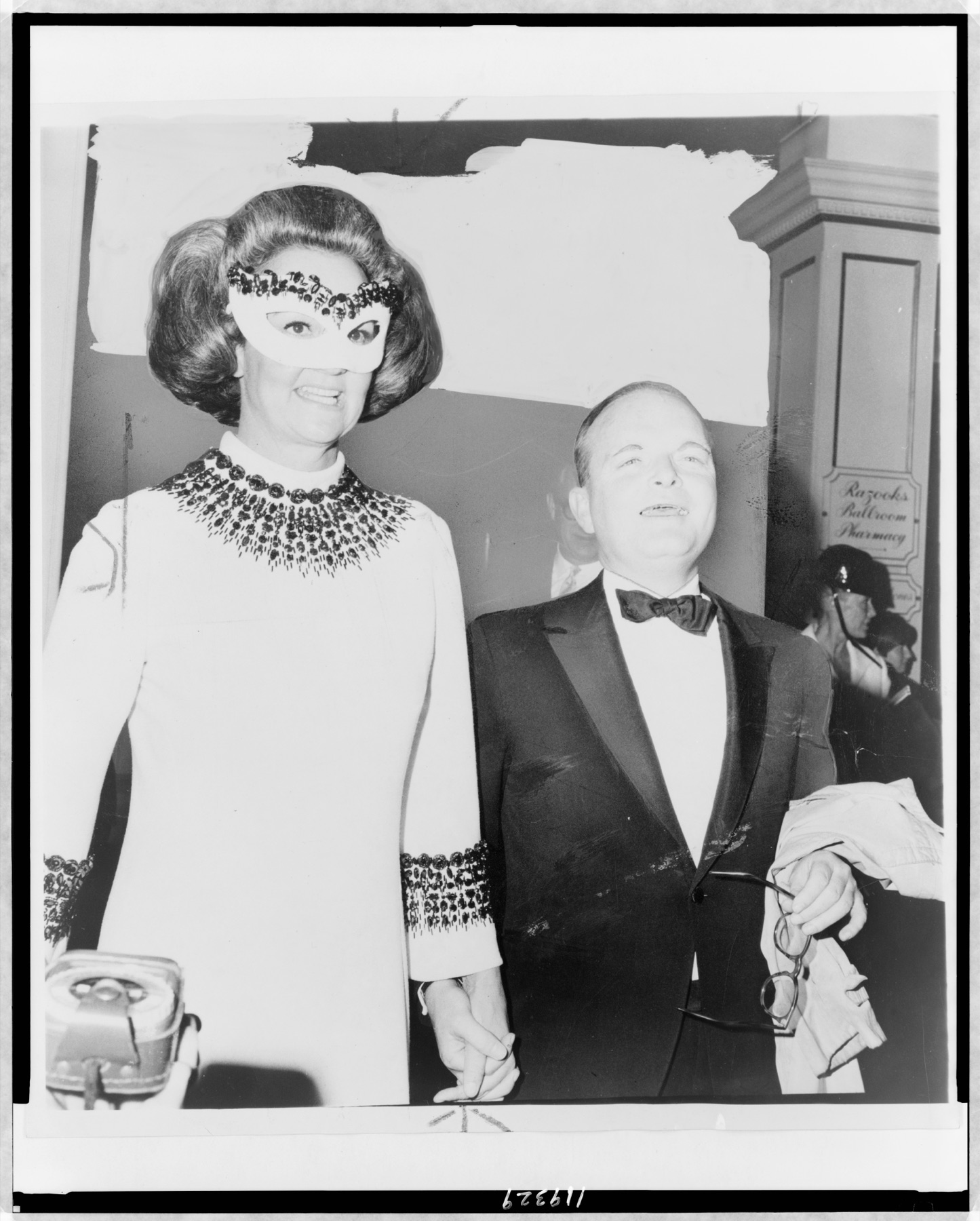
The morning after the party, the guest list was in the newspaper. On 29 November 1966 the New York Times printed the names of the people Truman Capote had invited to his ball at the Plaza the night before: a long column of type that readers could run a finger down, looking for friends, rivals and, with luck, themselves.
That was the point. Time's report a week later counted "540 most intimate friends" and caught Leo Lerman of Mademoiselle muttering at the door: "The guest book reads like an international list for the guillotine." The party lasted one night. The list has lasted sixty years.
The book
Capote built it by hand. The New York Public Library, which holds his papers, describes "the black and white standard composition book in which Capote entered the names and addresses of his guests". Gloria Steinem, who was invited and wrote the night up for Vogue, called it "a ten-cent lined notebook". Beside each name he later wrote the host of the dinner party that guest would attend first, because nobody ate at the ball itself until midnight. The library also keeps a typed carbon of the list and a third version, alphabetized and tab-indexed, made for the people checking names at the door.
The invitation that went out was printed with a pointed choice of word. "Mr. Truman Capote requests the pleasure of your company at a black and white dance," it read: a dance, not a ball. "On Monday, the twenty-eighth of November at ten o'clock. Grand Ballroom, the Plaza." In the corner sat the rules: "Gentlemen: Black tie: black mask. Ladies: Black or white dress, white mask; fan." On the copy now at the Museum of the City of New York, someone added a line in pen: "in honor of Mrs. Katharine Graham."
The guest of honour
Graham was the publisher of the Washington Post. She later wrote that Capote rang "to cheer me up" and that she understood her role exactly: "I was a prop." She called herself "a sort of middle-aged debutante" and "not in competition with his more glamorous friends", and asked the question everyone else was asking: "Why was I the guest of honor? Who knows?" Capote let her bring twenty couples from Washington.
His biographer had a sharper reading, which Graham quoted in her memoir: she was "arguably the most powerful woman in the country, but still largely unknown outside Washington", and the ball was Capote's "ultimate act as Pygmalion". Whichever was true, the photograph from that night shows her masked, holding Capote's hand. Time quoted her afterwards: "I can't bear to think that there may never be another party like this."
The worlds in the room
Graham herself said guests came from "New York, Kansas ... California, Europe, Asia, South America". Follow a few of them through the doors and the list turns into a map.
Kansas. Capote did not leave behind the friends he had made in Kansas while researching In Cold Blood, his account of the Clutter family murders. Time reported that "jets from ... Garden City, Kans., flew in the guests", and that Capote had invited eleven Kansans. Among them were Alvin Dewey, the Kansas Bureau of Investigation agent who led the case, and his wife Marie. The library holds photographs of Dewey being interviewed on his way in, and of the couple walking into the ball. Their masks, and Marie's gown, are kept today in a county museum in Garden City.
Hollywood. Frank Sinatra came with Mia Farrow; Elliott Erwitt photographed them that night, and Time noted that the pair later "drifted out to his favorite West Side bar". Candice Bergen wore a white mink bunny mask by Halston, made first for Marisa Berenson. Asked about it decades later, she called the night "New York at its most vicious". Henry Fonda, Lauren Bacall and Jerome Robbins were among the arrivals Time listed.
Washington. The President's daughter, Lynda Bird Johnson, "danced on and on with Actor Roddy McDowall", Time reported.
Letters and power. Time counted writers (Edward Albee, Marianne Moore, Norman Mailer), intellectuals (Arthur Schlesinger Jr., William Buckley) and official Washington (Nicholas Katzenbach, Jacob Javits) among the arrivals. Steinem came as a guest and went home with a magazine story.
The help. The list also ran below stairs. Elizabeth Hylton, Graham's secretary, was invited in her own right; interviewed in 2013, she said of the party: "It was like the day after Christmas." Later accounts add a doorman from the U.N. Plaza, who is said to have twirled Graham around the floor. Nobody has yet found his name.
Who didn't come
Here is the trap in the most famous guest list of the century: it is a list of invitations, not of guests. Capote, Time reported, gave the paper his list "not bothering to cross off those who had regretted or who had not come". By Time's own count the printed list included three ambassadors, Governor Nelson Rockefeller, Mayor John Lindsay and three Kennedys (Jackie, Bobby and Teddy), none of whom came. Even Graham was caught out: her memoir names the writer Katherine Anne Porter among the guests, but Porter, according to a 1996 reconstruction of the night, was ill in bed.
How many people the list held is still argued over. Time and Steinem both said 540. One retelling has 480 cards going out in October before the roll swelled. When the party ended at 3:30 in the morning, Time counted "more than 200 stalwarts" still standing.
The night itself
Shortly after 10 p.m., Time reported, masked figures "ducked in out of the rain, past the reporters and TV lights in the lobby". Peter Duchin's orchestra played, and Time said the bands "alternated rock 'n' roll and pop tunes". There were 450 bottles of nonvintage Taittinger. Supper came at midnight: chicken hash and spaghetti are in every account of the menu, though the rest of it depends on who is telling.
The masks were their own social register. Capote's cost 39 cents, a plain domino from F.A.O. Schwarz. Time reported that some women spent "$600 and more". Halston made Graham's to match her dress.
They did not stay on long. Capote's plan was that "when the masks come off at midnight, you can find out who your new chums are". In practice, Time reported, most men put theirs in their pockets as soon as they arrived ("It itches, and I can't see," said Alfred Gwynne Vanderbilt), and the women followed "long before the magical hour of midnight".
The ones he left off
Every list implies another list. Capote is said to have teased friends: "Well, maybe you'll be invited and maybe you won't." The names of the people who weren't invited, and what they did about it, come almost entirely from interviews given decades later. They include Ina Claire, who is said to have pleaded by telegram; the critic Kenneth Tynan, who had panned In Cold Blood; and George Hamilton, the beau of the President's daughter. One story has some of the uninvited leaving town for the night so nobody would know. The line that Capote "invited 500 friends but made 15,000 enemies" has been repeated for decades; nobody has found him saying it.
What survives for certain is the book itself, in a box at the New York Public Library, with its names, its addresses and, against each, the dinner where that guest would wait out the hours before the dance.
The Record
- The list. The New York Times printed the invitee list on 29 November 1966, with Charlotte Curtis's report, "Capote's Black and White Ball: 'The Most Exquisite of Spectator Sports'" (subscription archive). The Library of Congress's Headlines & Heroes blog confirms the date. A transcription is in Appendix A of Sarah Jane Rodman's Harvard thesis, Party of the Century (2014). Capote's composition book, the typed copy and the door list are described in the NYPL Guide to the Truman Capote Papers, Series IX.
- Contemporary report. "Parties: Truman's Compote", Time, 9 December 1966: the 540 figure, Lerman's quote, Graham's quote at the ball, the guests named here (Sinatra and Farrow, Lynda Bird Johnson, Fonda, Bacall, Robbins, Mailer and the writers, intellectuals and officials), the regrets printed on the list, the Kansas guests, the champagne, the masks (and how quickly they came off) and the 3:30 a.m. finish.
- The invitation. Museum of the City of New York, invitation and admittance card, and its online exhibition Truman Capote's Black and White Dance (gowns and masks).
- First-hand accounts. Katharine Graham, Personal History (1997), excerpted in Newsweek, "Social Life" section; Gloria Steinem in Vogue, January 1967, excerpted by Longreads; Candice Bergen to CBS Sunday Morning (2024); Elizabeth Hylton in Rodman's thesis (2013 interview). Graham's and Bergen's are recollections written or told decades later.
- Photographs. The lead photograph is in the Library of Congress with no known restrictions on publication. Elliott Erwitt's photographs of the night are at Magnum.
- Later retellings. Amy Fine Collins, "A Night to Remember", Vanity Fair, July 1996, built on interviews with guests and staff, is the source for Porter's illness, the 480 cards, the U.N. Plaza doorman and the snubs. Deborah Davis's Party of the Century (2006), in an extract in The Independent, adds the doorman's dance with Graham.
- What is uncertain. The exact number of names on the printed list is unresolved: 540 is the contemporary figure, Vanity Fair says "well in excess of 540", and a rough count of the thesis transcription comes out nearer 480–490. Who handed the list to the Times is disputed: Time says Capote gave it; Capote later claimed a reporter took it off the registration desk, and the Times's Enid Nemy, who co-reported the ball, said, "Truman provided the list." The menu varies between accounts beyond chicken hash and spaghetti (Slate sets out the versions). The cost is given as about $16,000 by Capote's biographer and "as high as $20,000" by Time.
- Disputed anecdotes. The named snubs, the friends who left town and the "15,000 enemies" line all come from later retellings, not from 1966 coverage. Katherine Anne Porter appears among the guests in Graham's memoir, but later reporting says she was too ill to attend; we have not counted her.
Steal This Idea
Copy the card. Call it a dance, give a firm start time and put the dress rule in a corner block: black and white only, and a mask for everyone. Capote's own mask cost 39 cents, so nobody needs to spend more. Send guests to eat somewhere first, start late, and serve a midnight supper of something simple (chicken hash and spaghetti have the precedent) with plenty of cold champagne. Make the unmasking at midnight an event, so people actually keep theirs on until then: Capote's guests didn't. And make your list on purpose: put the people from different parts of your life in the same room and see what happens.